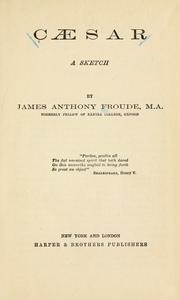
Caesar
- First published
- 1879
- Reading level
- Plain English
- Price
- Free
About the book
"Caesar: A Sketch" by James Anthony Froude is a historical account written in the late 19th century. This work examines the life and historical significance of Julius Caesar, exploring the transition of the Roman Republic into a military empire and the complex political climate of the era. Froude's analysis delves into the societal structures, key figures, and significant events that shaped Rome during Caesar's time, providing insights into both Caesar's character and the broader implications of his leadership. The opening of "Caesar: A Sketch" presents a thorough prelude to the study of Julius Caesar and the fall of the Roman Republic, establishing key themes of political power and moral decay within Roman society. Froude discusses the limited historical resources available for a complete portrait of Caesar, emphasizing the reliance on ancient accounts by figures like Suetonius and Cicero. The text describes how the early Romans had a unique capability for self-governance, contrasting with the later corruption and decline of civic virtue, which ultimately paved the way for Caesar's rise to power. Through an analysis of the institutions and character of the era, Froude underscores the inevitable trends leading to the transformation of Rome from a republic into an autocratic rule, setting the stage for Caesar's historical narrative.
- Caesar, Julius
- Rome
Updated September 2026. Public domain in the USA. Text and summary from Project Gutenberg eBook #8425.
More free books by James Anthony Froude
About James Anthony FroudeThe reign of Mary Tudor
History of England from the Fall of Wolsey to the Death of Elizabeth. Vol. III
The Divorce of Catherine of Aragon
Short Studies on Great Subjects
History of England from the Fall of Wolsey to the Death of Elizabeth. Vol. II.
The Earl of Beaconsfield
The English in the West Indies
The Reign of Henry the Eighth, Volume 1 (of 3)
Bunyan
Essays in Literature and History
English Seamen in the Sixteenth Century