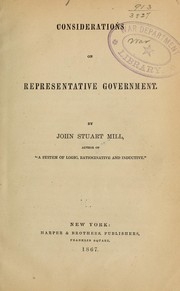
Considerations on Representative Government
- First published
- 1861
- Reading level
- Demanding
- Price
- Free
About the book
"Considerations on Representative Government" by John Stuart Mill is a philosophical treatise written during the mid-19th century. The book argues for the merits of representative government and explores the conditions under which various forms of government may be effective or beneficial to society. Mill seeks to address and reconcile opposing theories regarding the organization and functionality of political institutions, ultimately positing that representative systems can enhance civic participation and individual moral development. The opening of the treatise establishes Mill's intent to examine the fundamental principles and practical implications of government structures, particularly in light of contemporary political debates. Mill notes a prevailing skepticism among both Conservatives and Liberals regarding their political doctrines and articulates the necessity of a more comprehensive understanding of governance that transcends mere compromise. He outlines two conflicting perspectives on political institutions: one that views them as products of human design and another that regards them as organic developments shaped by historical and cultural factors. This framing sets the stage for Mill's insights into why representative government may be ideal, as he believes it can foster citizen involvement and promote an active and responsible populace.
- Representative government and representation
Updated September 2026. Public domain in the USA. Text and summary from Project Gutenberg eBook #5669. Considerations on Representative Government on Wikipedia.
More free books by John Stuart Mill
About John Stuart MillOn Liberty
Utilitarianism
A System of Logic, Ratiocinative and Inductive
Principles of Political Economy
The Subjection of Women
Autobiography
A System of Logic
A System of Logic, Ratiocinative and Inductive (Vol. 1 of 2)
Auguste Comte and Positivism
Essays on some unsettled Questions of Political Economy
Socialism
The Contest in America