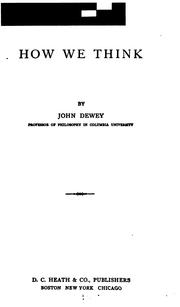
How We Think
by John Dewey
- First published
- 1909
- Reading level
- Fairly demanding
- Price
- Free
About the book
"How We Think" by John Dewey is an educational treatise written in the early 20th century. The work explores the importance of developing reflective thinking and outlines methods for effectively training thought processes in educational contexts. With an emphasis on the relationship between scientific inquiry and education, Dewey argues that fostering a scientific attitude in students is essential for promoting individual happiness and reducing social waste. The opening of the book presents a preface that highlights the challenges faced by educators, such as an overabundance of subjects and various teaching materials leading to distraction. Dewey asserts that a guiding principle—the scientific attitude—could bring unity and purpose to educational endeavors. He communicates the conviction that children possess a natural curiosity and capacity for scientific inquiry, which education should harness. The initial chapters also introduce key concepts regarding the nature of thought and the distinctions between various types of thinking, setting the stage for deeper exploration into the methods for training thought throughout the remainder of the work.
- Educational psychology
- Thought and thinking
Updated September 2026. Public domain in the USA. Text and summary from Project Gutenberg eBook #37423. How We Think on Wikipedia.
More free books by John Dewey
About John DeweyDemocracy and Education
Human Nature and Conduct
The public and its problems
The School and Society
Ethics
Leibniz's New Essays Concerning the Human Understanding
Reconstruction in Philosophy
Moral Principles in Education
Creative Intelligence
Essays in Experimental Logic
The Child and the Curriculum
Psychology and Social Practice