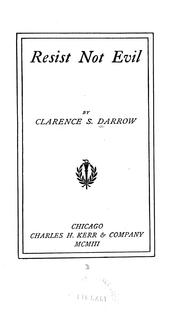
Resist not evil
- First published
- 1902
- Reading level
- Plain English
- Price
- Free
About the book
"Resist not evil" by Clarence Darrow is a political-philosophical treatise written in the early 20th century. It contends that states, armies, and courts are instruments of force, that punishment fails to reform or deter, and that non-resistance and humane solidarity offer the only rational path to social health. The opening of the treatise acknowledges Tolstoy’s influence and sets out a case for non-resistance by tracing the state’s origins to conquest and its modern continuity through armies, police, courts, and prisons. It argues that militarism burdens and brutalizes society, patriotism indoctrinates obedience, and standing armies chiefly exist to control domestic workers rather than repel foreign foes. Civil government is presented as militarism in disguise, enforcing property and class rule; punishment is portrayed as vengeance masquerading as justice, with shifting definitions of crime and arbitrary, harmful penalties. Early chapters attack deterrence—highlighting the brutalizing effect of public executions and the futility of prisons—and reframe crime as a social disease rooted in poverty, environment, and heredity, noting rises in “crime” in winter, hard times, and overcrowded old countries. They conclude that just judgment is impossible, proportional punishment cannot be measured, and state penalties multiply suffering by injuring families and communities, whereas food, opportunity, and kindness would address causes.
- Evil, Non-resistance to
- Punishment
- Criminal law
Updated September 2026. Public domain in the USA. Text and summary from Project Gutenberg eBook #76531.