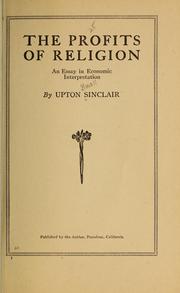
The Profits of Religion
- First published
- 1917
- Reading level
- Plain English
- Price
- Free
About the book
"The Profits of Religion: An Essay in Economic Interpretation" by Upton Sinclair is a critical analysis written in the early 20th century. This work examines religion from an economic perspective, arguing that it serves as both a source of income for clergy and a tool for maintaining social privilege and oppression. Sinclair uses evocative and satirical language to critique how institutionalized religion exploits its followers, connecting spiritual beliefs to financial gain and societal control. The opening of the book introduces the concept of "Bootstrap-lifting," a metaphor for how individuals labor under the illusion of spiritual elevation while being victimized by those who profit from their beliefs. Sinclair vividly describes a scene where people strain to lift themselves by their bootstraps, while a pickpocket reaps the rewards of their distraction. This introduces a series of critiques regarding various religious practices, asserting that many so-called spiritual exercises distract from the material realities of life and facilitate exploitation. Through these observations, Sinclair sets the stage for a broader examination of religious institutions as impediments to social progress, establishing a provocative foundation for his economic critique of culture.
- Christianity
Updated September 2026. Public domain in the USA. Text and summary from Project Gutenberg eBook #1558.