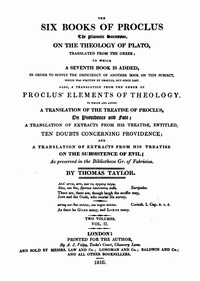
The six books of Proclus, the Platonic successor, on the theology of Plato (vol. 2 of 2)
by Proclus
- Price
- Free
About the book
"The six books of Proclus, the Platonic successor, on the theology of Plato…" is a philosophical translation and compendium written in the early 19th century. It presents an English rendering and arrangement of Neoplatonic theology, laying out a systematic hierarchy of divine orders, the Demiurge, and the principles by which unity, intellect, and soul structure the cosmos. Expect dense, technical metaphysics anchored in Platonic dialogues and mythic theonyms, aimed at readers of classical philosophy, theology, and the history of ideas. The opening of "The six books of Proclus, the Platonic successor, on the theology of Plato…" delineates the supermundane “ruling” gods whose assimilative powers bind lower realities to intelligible paradigms and sustain sympathy throughout the cosmos. It recapitulates the ascent from intelligible to intellectual orders, then situates the ruling order as the distributor of likeness, measure, and order across all levels, explaining procession and return through similitude. Drawing on Timaeus, Gorgias, Politicus, Laws, Philebus, and Cratylus, it develops three triads: a paternal triad (a twofold Jupiter with Neptune and Pluto) governing essence, life and motion, and formal division with conversion; a vivific Coric triad (Ceres with a twofold Core/Proserpine and the Minerva–Diana complex) supplying soul, virtue, and generative life; and a convertive, Apollonian–solar triad that reveals truth, purifies disorder, and harmonizes the whole. The text maps these powers onto cosmic regions (inerratic, planetary, sublunary; heights, middles, underworld; east, middle, west) and treats the sun/Apollo as a supermundane source of light and intellect that perfects and elevates all things.
- Theology
- Neoplatonism
- Plato
Updated September 2026. Public domain in the USA. Text and summary from Project Gutenberg eBook #78800.