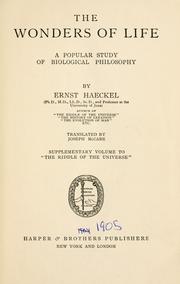
The Wonders of Life
- First published
- 1901
- Reading level
- Fairly demanding
- Price
- Free
About the book
"The Wonders of Life: A Popular Study of Biological Philosophy" by Ernst Haeckel is a scientific publication written in the early 20th century. This work serves as a comprehensive exploration of biological philosophy, building upon the author's earlier work, "The Riddle of the Universe." Haeckel delves into the intricacies of life, the nature of living organisms, and the principles of monistic philosophy, providing insight into biological phenomena and their underpinnings. The beginning of the book introduces the central themes of truth and the pursuit of knowledge, positioning biology within the larger framework of natural philosophy. Haeckel discusses the relationship between science and philosophy, asserting that true understanding emerges from a blend of empirical observation and rational thought. He critiques dualistic theories and emphasizes a monistic approach, promoting the idea that knowledge is inherently tied to physiological processes within the brain. In doing so, he sets the stage for a detailed examination of life, its definitions, and its complexities throughout the remainder of the text.
- Biology
- Evolution (Biology)
- Life
Updated September 2026. Public domain in the USA. Text and summary from Project Gutenberg eBook #46652.
More free books by Ernst Haeckel
About Ernst HaeckelReport on the Radiolaria Collected by H.M.S. Challenger During the Years 1873-1876, First Part
The Evolution of Man
The History of Creation, Vol. 1 (of 2)
The History of Creation, Vol. 2 (of 2)
Freedom in Science and Teaching.
The Riddle of the Universe at the close of the nineteenth century
The Evolution of Man — Volume 1
The Last Link
Monism as Connecting Religion and Science
The Evolution of Man — Volume 2
Last Words on Evolution