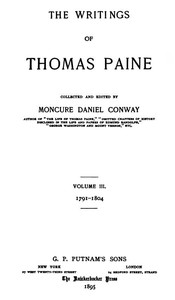
The Writings Of Thomas Paine, Volume III.
by Thomas Paine
- Reading level
- Fairly demanding
- Price
- Free
About the book
"The Writings of Thomas Paine, Volume III" by Thomas Paine is a historical collection of political writings created in the late 18th and early 19th centuries. This volume encompasses works advocating for republicanism and critiquing monarchy, illustrating Paine's fervent interpretation of democracy and human rights during a transformative period of political upheaval in both America and France. The likely topics include proclamations for republican governance, letters addressing political figures, and essays on the rights of man, reflecting Paine's significant influence on revolutionary thought. At the start of the volume, the introduction highlights the context in which Paine's works were created, particularly his collaborations and relationships with notable figures during the French Revolution. It reveals that the initial sections include his "Republican Proclamation," which argues against the necessity of monarchy and emphasizes the burdensome nature of kingship on society. Paine articulately contends that the absence of a king is preferable and underscores the importance of establishing a republic as a foundation for a just society. Alongside this, the opening introduces his correspondence with various political figures, indicating his active role in the social and political reforms of his time, and sets the tone for the crucial discussions on governance and the rights of individuals that follow in the subsequent essays.
- Political science
Updated September 2026. Public domain in the USA. Text and summary from Project Gutenberg eBook #31271.
More free books by Thomas Paine
About Thomas PaineCommon Sense
The Writings of Thomas Paine, Complete
The Writings of Thomas Paine — Volume 2 (1779-1792)
The Writings of Thomas Paine — Volume 4 (1794-1796)
The Writings of Thomas Paine — Volume 1 (1774-1779)
A Letter Addressed to the Abbe Raynal, on the Affairs of North America, in Which the Mistakes in the Abbe's Account of the Revolution of America Are Corrected and Cleared Up