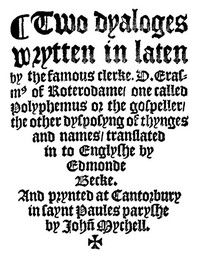
Two Dyaloges (c. 1549)
by Erasmus
- Reading level
- Plain English
- Price
- Free
About the book
"Two Dyaloges (c. 1549)" by Desiderius Erasmus is a collection of dialogues that explore themes of morality, hypocrisy, and the nature of faith, written during the early Renaissance period. This work serves as a critique of contemporary religious and social practices through a satirical lens, making it relevant for readers interested in the intersection of religion, ethics, and human behavior in historical contexts. In the dialogues, two characters, Poliphemus and Cannius, engage in witty exchanges that delve into the superficiality of outward appearances and the true essence of faith. Poliphemus, the gospeller, presents himself as a devout bearer of the gospel while displaying behaviors that contradict Christian teachings. Cannius challenges Poliphemus on various points, questioning his authenticity and adherence to the true spirit of the gospel. Through their conversation, Erasmus highlights the disparity between external piety and internal morality, using humor and irony to persuade readers to reflect on their own beliefs and actions. The second dialogue further examines the significance of names and reputation, contrasting genuine virtue with the vain pursuit of social status. Overall, the book encourages a deeper understanding of true moral integrity beyond mere appearances.
- Dialogues, Latin (Medieval and modern)
Updated September 2026. Public domain in the USA. Text and summary from Project Gutenberg eBook #14500.
More free books by Erasmus
About ErasmusIn Praise of Folly
The Praise of Folly
The Colloquies of Erasmus, Volume I.
Erasmus Against War
Selections from Erasmus
The Education of Children
A dialoge or communication of two persons
A Modest Meane to Mariage
A Very Pleasaunt & Fruitful Diologe Called the Epicure
A Merry Dialogue Declaringe the Properties of Shrowde Shrews and Honest Wives
One dialogue, or Colloquye of Erasmus (entituled Diuersoria)