
Charles Darwin published 9 novels, 1 novella, 15 non-fiction books and 4 other books, beginning with Journal of Researches into the Natural History and Geology of the Countries Visited During the Voyage of H.m.s. Beagle Round the World (1845). The best-known is On the Origin of Species by Means of Natural Selection (1859).
Updated September 2026
Where to start with Charles Darwin
Standalone novels in order

Zoology of the Voyage of H.M.S. Beagle (1838), with Richard Owen and John Gould
Geological Observations on the Volcanic Islands (1844)

A Manual of Scientific Enquiry: Prepared for the Use of Her Majesty's Navy and Adapted for Travellers in General (1849), with John Frederick William Herschel and Richard Owen

On the Various Contrivances by Which British and Foreign Orchids Are Fertilised by Insects, and on the Good Effects of Intercrossing (1862)
Novellas in order
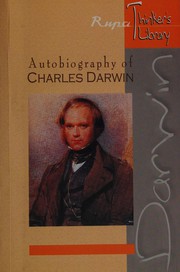
The Autobiography of Charles Darwin (2001), with Francis Darwin
Non-fiction in order

Journal and Remarks (1839)
The Structure and Distribution of Coral Reefs (1842)
Journal of Researches into the Natural History and Geology of the Countries Visited During the Voyage of H.m.s. Beagle Round the World (1845)
Journal of Researches During the Voyage of H.m.s. "Beagle" (1860)
Insectivorous Plants (1875)
The Effects of Cross and Self Fertilisation in the Vegetable Kingdom (1876)
A Naturalist's Voyage (1879)

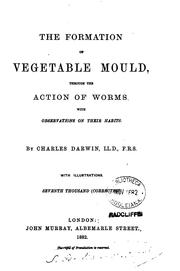
The Formation of Vegetable Mould Through the Action of Worms, with Observations on Their Habits (1881)
The Life and Letters of Charles Darwin: Including an Autobiographical Chapter (1888)
correspondence of Charles Darwin (1985)
Other books in order

The Formation of Vegetable Mould (1881)


The Various Contrivances by Which Orchids Are Fertilised by Insects (1882)
Free to read
All free classicsLife and Letters of Charles Darwin — Volume 1
More Letters of Charles Darwin — Volume 1
The Origin of Species by Means of Natural Selection
The Voyage of the Beagle
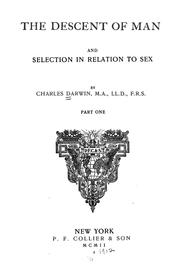
The Descent of Man and Selection in Relation to Sex, Vol. I
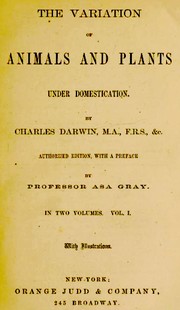
The Variation of Animals and Plants Under Domestication, Vol. I.
The Variation of Animals and Plants Under Domestication, Volume II (of 2)
Journal of Researches into the Natural History and Geology of the Countries Visited During the Voyage Round the World of H.M.S. Beagle Under the Command of Captain Fitz Roy, R.N.
A Monograph on the Sub-class Cirripedia (Volume 2 of 2)
The Descent of Man and Selection in Relation to Sex, Vol. II (1st Edition)
Charles Darwin
The Variation of Animals and Plants under Domestication
More Letters of Charles Darwin — Volume 2
Darwinism stated by Darwin himself



About Charles Darwin
Charles Robert Darwin was an English naturalist, geologist, and biologist, widely known for his contributions to evolutionary biology. His proposition that all species of life have descended from a common ancestor is now generally accepted and considered a fundamental scientific concept. In a joint presentation with Alfred Russel Wallace, he introduced his scientific theory that this branching pattern of evolution resulted from a process he called natural selection, in which the struggle for existence has a similar effect to the artificial selection involved in selective breeding. Darwin has been described as one of the most influential figures in human history and was honoured by burial in Westminster Abbey.
Biography from Wikipedia, CC BY-SA 4.0. Photo via Wikimedia Commons.
Charles Darwin FAQ
- How many books has Charles Darwin written?
- Charles Darwin published 9 novels, 1 novella, 15 non-fiction books and 4 other books that we list, as of September 2026.
- What order should I read Charles Darwin's books in?
- Publication order is a safe choice; the full list is above. Most readers start with On the Origin of Species by Means of Natural Selection.
- What is Charles Darwin's last book?
- The Formation of Vegetable Mould Through the Action of Worms, with Observations on Their Habits (1881).
- What is Charles Darwin's most famous book?
- On the Origin of Species by Means of Natural Selection (1859) is Charles Darwin's most widely read book.
- Can I read Charles Darwin's books for free?
- Yes. 33 books by Charles Darwin are in the public domain in the US and free to read online or download here.
Authors like Charles Darwin


Sources: book lists and dates from Wikidata and Open Library, ratings from Open Library readers, free texts from Project Gutenberg. Last updated September 2026.