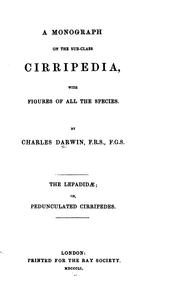
A Monograph on the Sub-class Cirripedia (Volume 1 of 2)
- First published
- 1851
- Reading level
- Fairly demanding
- Price
- Free
About the book
"A Monograph on the Sub-class Cirripedia (Volume 1 of 2)" by Charles Darwin is a scientific publication written in the mid-19th century. The work focuses on the systematic classification and detailed anatomical study of Cirripedia, a subclass of crustaceans that includes barnacles. The monograph is significant for its comprehensive examination of various species within this group and their biological attributes, contributing to the understanding of biodiversity in marine life. The opening of the monograph includes a preface in which Darwin expresses his gratitude to numerous naturalists, acknowledging their contributions to the research and collection of specimens used in his study. He originally planned to describe only a single abnormal specimen but, encouraged by others, expanded his scope to cover the entire sub-class. Darwin highlights the challenges in classifying Cirripedia due to their variability and internal complexity. He notes the extensive assistance he received and the wealth of materials made available for his research, setting the stage for a detailed exploration of Cirripedes in subsequent chapters.
- Lepadidae
- Cirripedia
Updated September 2026. Public domain in the USA. Text and summary from Project Gutenberg eBook #31558.
More free books by Charles Darwin
About Charles DarwinLife and Letters of Charles Darwin — Volume 1
More Letters of Charles Darwin — Volume 1
On the Origin of Species By Means of Natural Selection
The Origin of Species by Means of Natural Selection
The Descent of Man, and Selection in Relation to Sex
The Voyage of the Beagle
The Expression of the Emotions in Man and Animals
The Descent of Man and Selection in Relation to Sex, Vol. I
The Variation of Animals and Plants Under Domestication, Vol. I.
The Variation of Animals and Plants Under Domestication, Volume II (of 2)
The Foundations of the Origin of Species
The Autobiography of Charles Darwin