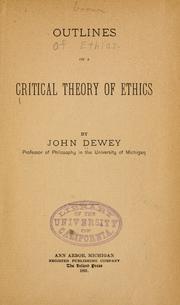
Outlines of a Critical Theory of Ethics
by John Dewey
- First published
- 1891
- Reading level
- Fairly demanding
- Price
- Free
About the book
"Outlines of a Critical Theory of Ethics" by John Dewey is a philosophical treatise on ethical theory written in the late 19th century. The work presents a thorough examination of key ethical concepts, such as the nature of the good, obligation, and freedom, situating these within the contemporary context of moral philosophy. Dewey's aim is to advance a critical theory that evaluates the ideas and institutions shaping moral conduct, encouraging readers to understand ethics as a dynamic process rather than a static set of rules. At the start of the text, Dewey introduces the concept of ethics, distinguishing it from other branches of philosophy by emphasizing its focus on the moral evaluation of human conduct. He articulates that ethics is not merely descriptive, like anthropology or psychology, but is primarily concerned with the inherent worth of actions in relation to their ends. Dewey outlines the foundational problems of ethics, including the identification of true conduct, the nature of moral obligation, and the importance of individual freedom within a social context. Through this exploration, he sets the stage for an elaborate discussion on various ethical theories and their implications for understanding human behavior and societal norms.
- Ethics
Updated September 2026. Public domain in the USA. Text and summary from Project Gutenberg eBook #60422.
More free books by John Dewey
About John DeweyDemocracy and Education
How We Think
Human Nature and Conduct
The public and its problems
The School and Society
Ethics
Leibniz's New Essays Concerning the Human Understanding
Reconstruction in Philosophy
Moral Principles in Education
Creative Intelligence
Essays in Experimental Logic
The Child and the Curriculum