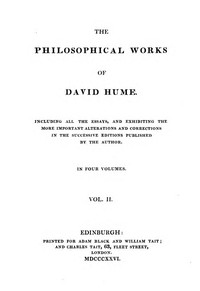
Philosophical Works, v. 2 (of 4)
by David Hume
- Reading level
- Fairly demanding
- Price
- Free
About the book
"Philosophical Works, v. 2 (of 4)" by David Hume is a philosophical treatise written in the early 19th century. This volume primarily explores the nature of human emotions, specifically the passions of pride and humility, and their underlying psychological mechanisms. It aims to systematically analyze how these emotions arise, their causes and effects, and how they relate to self-perception and social interactions. The opening of this volume sets the stage for a thorough examination of pride and humility. Hume begins by distinguishing between original and reflective impressions within the realm of human perception and emotions. He discusses how these two passions are directly opposed but share the same object—self. Hume emphasizes that pride arises from favorable perceptions of oneself, while humility stems from unfavorable views. He also notes that the causes of these passions are varied, extending beyond just personal attributes to include external possessions and social status. Throughout this exploration, Hume emphasizes the importance of both the qualities producing pleasure or pain and their relationship to the self, laying a foundation for understanding the complexities of human emotions.
- Knowledge, Theory of
- Philosophy, English
Updated September 2026. Public domain in the USA. Text and summary from Project Gutenberg eBook #53792.
More free books by David Hume
About David HumeAn Enquiry Concerning Human Understanding
A Treatise of Human Nature
An Enquiry Concerning the Principles of Morals
Dialogues Concerning Natural Religion
Philosophical Works, v. 1 (of 4)
Hume's Political Discourses
The History of England in Three Volumes, Vol. I., Part A.
Essays
The History of England in Three Volumes, Vol. I., Part B.
The History of England in Three Volumes, Vol. I., Part C.
The History of England in Three Volumes, Vol. I., Part E.
The History of England in Three Volumes, Vol. I., Part D.